
In short
- Prove the loss first. A bucket on the pool step loses water to the air at the same rate as the pool, so if the pool falls further than the bucket, the difference is a leak.
- Run the test twice, pump on and pump off. More loss with the pump running points at the return side, more with it off points at the suction lines, and the same either way points at the shell or a fitting in it.
- At Overstrand's 2026/27 tariffs, an 8 m by 4 m pool losing an extra 10 mm a day adds about R476 a month in water and sewerage for a household already using 15 kl.
- When the tests say leak but no fitting gives itself away, the rest is pressure testing, acoustic listening and cameras, with the pool full and the paving left down.
Knowing how to find a leak in a pool saves two kinds of money in Hermanus: the top-ups you pay for while you wonder, and the call-out you pay for when the pool was only losing water to a windy week. The order matters more than any tool. Prove the loss is real, work out which part of the pool is losing it, and only then decide whether it needs a professional search.
This guide is about diagnosis, so that you know what to tell a plumber in Hermanus and when to call one. It leaves out repairs: most pool leaks sit behind a fitting or under paving, where a repair is only as good as the finding.
Step 1 In Finding A Pool Leak: Rule Out Evaporation, Splash-Out And Backwashing
Every pool loses some water without leaking:
- Evaporation rises with sun, dry air and above all wind across the surface. Walker Bay faces south, which leaves Hermanus exposed to summer south-easterlies that can blow for days. Overstrand's permanent ban on watering gardens between 09:00 and 17:00 exists, the municipality says, to prevent unnecessary loss of water through evaporation. A pool is an open surface all day.
- Splash-out from swimmers, a dog or a water feature. None of it comes back.
- Backwashing sends pool water down the waste line. Several backwashes in one week look exactly like a leak.
The bucket test, done properly
Air takes water from a bucket and the pool at the same rate, so any extra drop in the pool is water going somewhere else.
- Stand a bucket on the first or second step of the shallow end, its rim well above the water.
- Fill it to the same height as the pool outside. Mark the level inside the bucket, and the pool level on tape outside it or on the tile.
- Close any automatic top-up valve. Don't top up, backwash or swim during the test.
- Leave it for at least 24 hours, two days if you can. Skip it if rain is forecast, because runoff from the paving spoils the comparison.
- Measure both drops in millimetres.
Equal drops mean the pool is losing water to the weather, not leaking. If the pool has dropped further than the bucket, the difference is the leak, and it is now a number rather than a suspicion.
Turn the millimetres into litres
One millimetre of level over one square metre of pool is one litre. An 8 m by 4 m pool has 32 square metres of surface, so an extra 10 mm a day is 320 litres a day, or about 9.6 kl a month. Write your figure down: it is the first thing a detection visit asks for.
Step 2: The Pump-On, Pump-Off Test For A Pool Leak
A pool has two sets of pipes. The suction side draws water from the skimmer and main drain to the pump. The return side pushes filtered water back through the return fittings, and is only under pressure while the pump runs. Run the bucket test twice, once with the pump on its normal timer and once with it off for the whole period, each against its own bucket.
| Result | What it points to |
|---|---|
| Loses more with the pump running | The return side: the return line, the return fittings, or the plant (pump, filter, multiport valve and the unions between them). |
| Loses more with the pump off | The suction side: the skimmer or main drain line. Under suction a cracked pipe can draw air in; once the pump stops, water runs out through the same crack. |
| Loses the same either way | The shell, or a fitting set into it: the skimmer throat, the light niche or a crack. |
The pump gives two more clues while it runs. Air bubbles in the lid basket, or coming back through the returns, mean the suction side is drawing air, often at a joint. Water trickling from the backwash line while the valve is on filter means the multiport valve is passing water to waste, a leak nobody sees because it goes straight down a drain.
With the pump off, a leaking pool often stops dropping at the height of the leak, just below the skimmer mouth or level with the light. Only watch for this with the pump off: a pump drawing on a level below the skimmer mouth sucks air and can run dry.
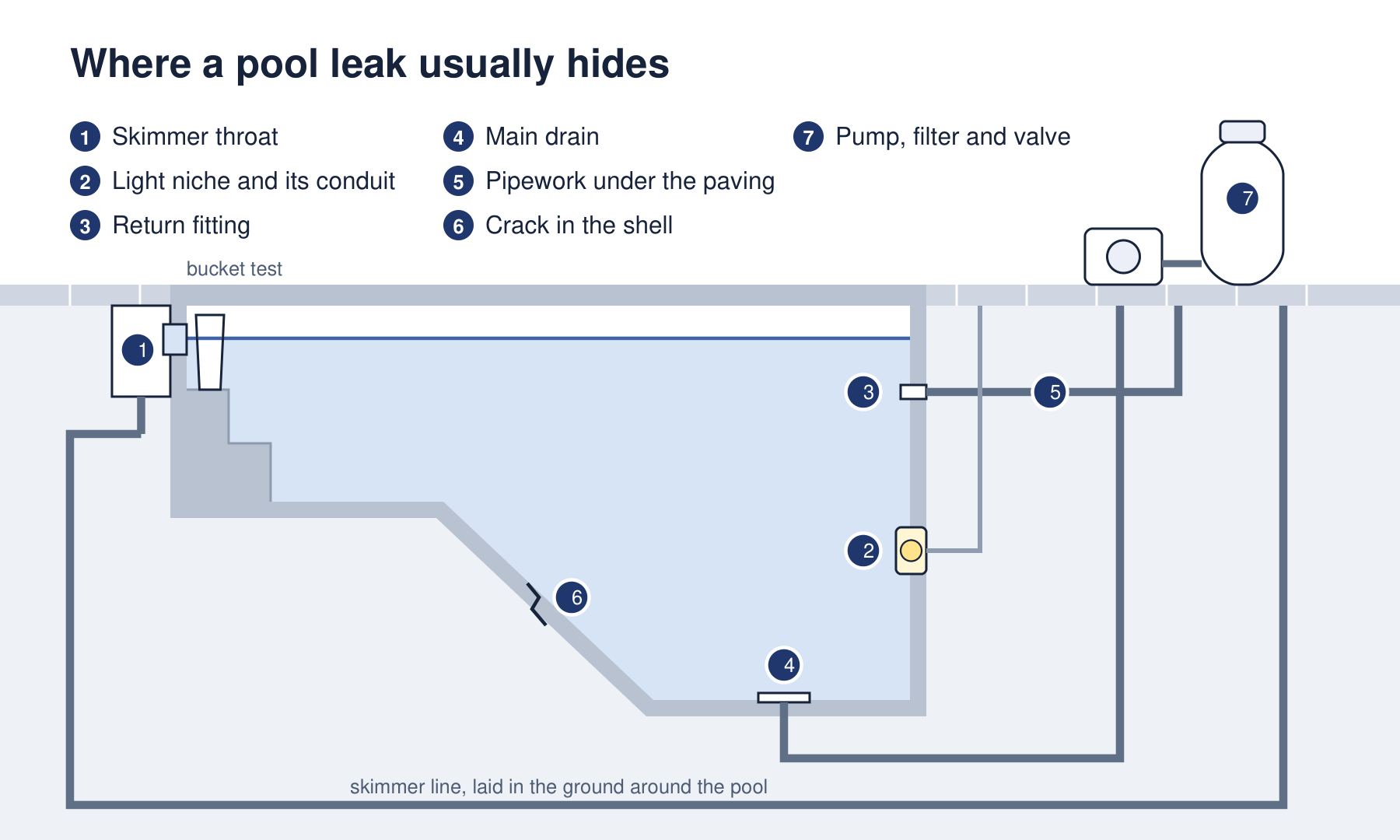
Where A Pool Leak Usually Hides
Most leaks are where something passes through the shell or where pipes join. The pump test tells you which to check first.
- The skimmer throat. The skimmer box is set into the wall at the water line, and the joint where it meets the shell can open into a gap.
- The light niche. Water can escape round the rim of the light, or along the conduit that carries its cable out under the paving.
- The return fittings. Each inlet passes through the wall, and the seal round it can fail.
- The main drain. At the deepest point, out of reach without going under, with its pipe running beneath the floor.
- The pipework under the paving. The buried runs to the pump show a leaking joint, if at all, as a damp patch, a sunken paver or a strip of garden that stays green when the rest is dry.
- Cracks in the shell. Usually the first suspicion, but a crack is only a leak if water moves through it.
The dye test at a fitting
Dye shows whether water is leaving the pool at one spot. Switch the pump off and wait until the water is completely still. Release a little leak-detection dye, or a few drops of food colouring, from a syringe right next to the suspect spot: the seam of the skimmer throat, the rim of the light, the edge of a return, or along a crack. Hold still and watch. Dye that drifts and spreads means no flow. Dye pulled into the gap in a thin line means water is leaving there.
Dye only works where you can reach without stirring the water, and it cannot find a leak in a buried pipe at all. If the pump test pointed at the lines, or the dye sits still at every fitting while the bucket keeps showing a loss, the search has gone past what you can see from the edge.
What A Pool Leak Costs In Hermanus At 2026/27 Tariffs
Overstrand bills household water in rising steps. From 1 July 2026 the normal tariff, including VAT, is R9.26 a kilolitre for the first 6 kl in a month, R18.99 from 7 to 18 kl, R39.80 from 19 to 45 kl, R79.58 from 46 to 60 kl and R109.17 above that. Sewerage on a house is charged on 70% of the water used, up to 50 kl of water, at R23.26 a kilolitre. So each top-up kilolitre in the 19 to 45 kl step costs about R56 with its sewerage.
Leaked water costs money when you replace it, by hose or automatic top-up, and it lands on top of what the household already uses, so it is charged at the highest step the account reaches.
| Extra loss beyond the bucket | Water lost a month (8 m by 4 m pool) | Extra a month, normal tariff | Extra a month, Level 2 or 3 restriction tariff |
|---|---|---|---|
| 5 mm a day | 4.8 kl | about R207 | about R245 |
| 10 mm a day | 9.6 kl | about R476 | about R572 |
| 20 mm a day | 19.2 kl | about R1,014 | about R1,225 |
For a household already using 15 kl a month, from Overstrand's 2026/27 tariff list including VAT. Fixed monthly charges are left out because a leak does not change them.
Overstrand has no water restrictions in force and no rule on filling pools. Its water status page, last updated in July 2026, put De Bos Dam at 100%. It has happened before, though. In September 2023, when Greater Hermanus ran short, the municipality ruled that pools could not be filled with municipal water until the restrictions were lifted on 3 November 2023. A leaking pool cannot simply be topped up under rules like that.
Finding A Pool Leak In A Holiday Home That Stands Empty
Overstrand describes itself as a holiday destination where the occupation of properties is unpredictable. If your house stands empty for weeks at a time, a pool leak behaves differently depending on how the pool is topped up.
- With an automatic top-up valve, the pool stays full and looks fine. The leak shows only on the water meter, turning in a house where nobody uses water. Our leak detection page covers what an empty house's meter tells you.
- Without one, the level falls, and once it drops below the skimmer mouth a pump running on its timer draws air and can run dry.
Before you lock up, put tape at the water line and photograph the water meter. Ask whoever checks the house to look at both. A level below the tape or a meter that has moved is a bucket test you did not have to run.
What A Professional Pool Leak Search Involves
Once you know there is a leak and roughly where, pool leak detection in Hermanus picks up where your tests stopped. A typical visit works through these methods with the pool full and nothing lifted until the leak is found:
- Pressure testing the lines. Each line is plugged at the pool end and held under pressure from the plant side. A line that cannot hold pressure on the gauge is leaking. This is how a buried pipe is tested without digging.
- Acoustic listening. Water escaping from a pressurised pipe makes a sound. A ground microphone moved along the pipe route, or a hydrophone at the fittings, narrows it to a spot.
- Dye at every fitting, including the main drain at the deep end.
- Cameras. An inspection camera inside a pipe shows a cracked joint, and an underwater camera can follow a crack or check a fitting closely.
The point is to mark the leak on the paving before anybody picks up a tool, so the repair opens one small area rather than a trench along the pipe run. Send your bucket figures from both pump runs when you book: they tell the plumber which tests to run first.
One exception: water coming up at the meter, in the pavement or in the street is not your pool. Report it to Overstrand on the Overstrand Citizen App or on 028 313 8111, answered 24 hours a day.
Questions Hermanus Pool Owners Ask
Is it normal for a pool to lose 12 mm of water a day?
It can be, on a hot day with a strong wind, so the number alone settles nothing. The bucket test does. If the bucket dropped by the same 12 mm, the weather took it. If the bucket dropped less, the difference is the leak.
What can I put in my pool to find a leak?
Leak-detection dye from a pool shop, or a few drops of food colouring, released next to a fitting with the pump off and the water still. It only shows a leak at the spot you test, so use it where the pump-on, pump-off test points.
Where is the most common place for a pool leak?
Wherever something passes through the shell or pipes join: the skimmer throat, the light niche, the return fittings and the main drain, plus the buried pipework between the pool and the pump. A visible crack is the usual first suspicion, but it only leaks if water moves through it.
Can a pool leak be found without draining the pool?
Yes. Every test in this guide, and every professional method, is done with the pool full. Draining a pool to look carries its own risk, because an empty shell can be pushed up by groundwater from below.
How much does it cost to check a pool for a leak?
It depends on the pool and on what your own tests have ruled out, so there is no honest single figure. We quote the investigation as a fixed figure before the visit, separate from any repair. The plumbing prices page explains how call-outs and quotes work.
Sources
- Overstrand Municipality: Tariff list 2026/2027 (final), water tariffs W1B and sewer tariffs SE7A (approved by Council on 29 May 2026, in force from 1 July 2026)
- Overstrand Municipality: Overstrand Council approves 2026/27 municipal budget (29 May 2026)
- Overstrand Municipality: Our dam levels and water status (July 2026 update, read 12 October 2026)
- Overstrand Municipality: drastic water restrictions implemented with immediate effect, including the swimming pool rule (28 September 2023)
- Overstrand Municipality: No water restrictions for Overstrand residents (21 November 2023)
- Overstrand Municipality (via Xplorio): Municipal accounts, meter readings and replacements (4 February 2022)
- Wikipedia: Walker Bay Whale Sanctuary, climate (citing Branch and Branch, The Living Shores of Southern Africa, 1985)
Written by The Hermanus Plumbers, a plumber in Hermanus based at 18 Royal Street, Hermanus, working across Hermanus, Onrus, Sandbaai and Vermont. This is general guidance; a plumber on site can tell you what applies to your property.